
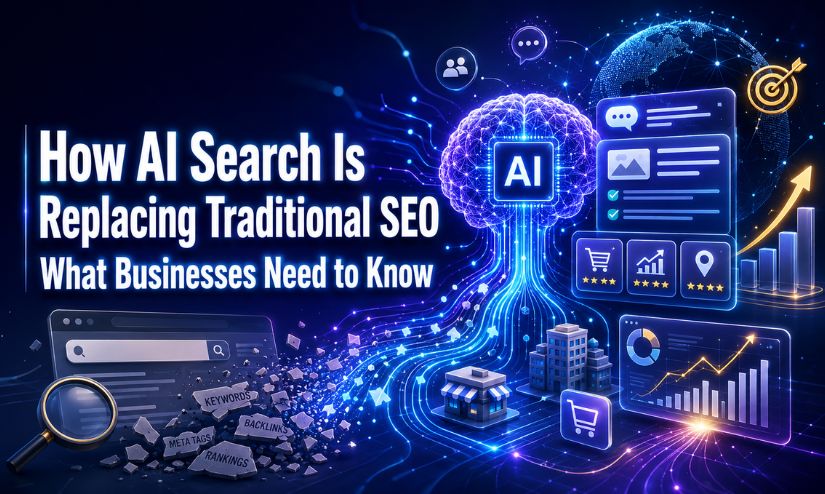
Search is evolving faster than ever. People no longer rely only on typing keywords into Google. Instead, they ask complete questions to AI assistants like ChatGPT, Gemini, Perplexity, and Bing AI, expecting instant and personalized answers.
This shift is changing how businesses attract online visitors. Ranking on a search engine results page is no longer the only goal. Brands now need content that AI systems understand, trust, and recommend.
If your website still focuses only on traditional SEO tactics, you could miss valuable traffic opportunities. This guide explains why AI Search is becoming the new standard and how businesses can adapt for long-term success.
Why AI Search Is Changing the Rules of SEO
AI Search uses large language models and advanced algorithms to understand user intent instead of matching exact keywords. Rather than displaying a list of links, AI provides direct answers by combining information from multiple trusted sources.
For businesses, this means visibility depends on content quality rather than keyword repetition.
For example, someone searching “How can a local clinic improve online visibility?” may receive an AI-generated answer mentioning websites that provide clear explanations, practical advice, and trustworthy information.
Modern AI Search prioritizes:
- Helpful and original content
- Clear page structure
- Natural language
- Topic authority
- User-focused answers
- Fresh and accurate information
Instead of optimizing for search engines alone, businesses should optimize for users and AI systems simultaneously.

What Businesses Should Focus on Instead of Traditional SEO
SEO is not disappearing. It is evolving into a broader strategy that combines Search Engine Optimisation, user experience, and content authority.
Successful businesses now create content that answers complete questions instead of targeting a single keyword repeatedly.
Effective AI-friendly content should include:
- Clear definitions near the beginning
- Logical heading structure
- Short and readable paragraphs
- Question-and-answer sections
- Real-world examples
- Internal linking to related resources
For instance, a healthcare website explaining Kidney Stone Treatment should describe symptoms, diagnosis, treatment options, recovery, and prevention in one comprehensive resource instead of producing multiple thin pages.
This approach improves search visibility while increasing user engagement and dwell time.
Businesses should also update older content regularly, ensuring statistics, recommendations, and examples remain accurate and useful.

EEAT and AI Visibility: The New Competitive Advantage
Experience, Expertise, Authoritativeness, and Trustworthiness (EEAT) have become more important than ever.
AI systems are designed to identify content that appears reliable and helpful. Pages that demonstrate genuine expertise are more likely to be referenced and recommended.
Businesses can strengthen EEAT by:
- Publishing original insights
- Including expert opinions
- Citing established industry knowledge
- Sharing practical examples
- Displaying author information
- Maintaining consistent brand messaging
Consider two blogs discussing digital marketing. One repeats generic advice copied from multiple websites, while the other explains actual campaign results, common mistakes, and actionable strategies based on experience.
The second article provides greater value and is more likely to earn backlinks, user trust, and AI citations.
Trust is becoming a ranking signal across both traditional search engines and AI-powered search experiences.

How to Prepare Your Website for the Future of Search
The future belongs to businesses that create comprehensive and user-first content.
Start by organizing your website around topics instead of isolated keywords. Build content clusters that answer every stage of a customer’s journey, from awareness to decision-making.
Best practices include:
- Write conversational content for voice search
- Add FAQ sections for quick answers
- Improve page speed and mobile usability
- Use descriptive headings
- Update existing articles regularly
- Build topical authority with related content
- Focus on solving user problems instead of chasing rankings
Businesses should also monitor how users interact with content. Longer engagement, lower bounce rates, and higher satisfaction signals indicate that pages meet user expectations.
As AI Search continues to evolve, helpful content will consistently outperform content written only for algorithms.

Conclusion
AI Search is not replacing SEO entirely—it is transforming it into a more intelligent, user-focused strategy. Businesses that prioritize high-quality information, EEAT principles, and natural language content will be better positioned to earn visibility across Google, ChatGPT, Bing, Perplexity, Gemini, and future AI platforms.
Instead of asking, “How do I rank for this keyword?” the better question is, “How can I provide the best answer to my audience?”
Organisations that embrace this mindset today will build stronger authority, attract more qualified visitors, and stay competitive in the rapidly changing search landscape.
Frequently Asked Questions
1. What is AI Search?
AI Search uses artificial intelligence to understand questions and generate direct answers instead of showing only a list of web pages.
2. Is traditional SEO becoming obsolete?
No. Traditional SEO remains important, but it now works alongside AI Search Optimization, user experience, and EEAT principles.
3. How can businesses optimize for AI Search?
Create comprehensive content, answer user questions clearly, use logical headings, demonstrate expertise, and keep information accurate and updated.
4. Why is EEAT important for AI Search?
EEAT helps AI systems identify trustworthy and authoritative content, increasing the likelihood of recommendations and higher visibility.
5. What type of content performs best in AI Search?
Well-structured, conversational, informative, and experience-based content that directly answers user intent performs best across AI-powered search platforms.